
Skip to content
Hynek Kraus
International expansion

Sell in more countries from one Shopify store.

New markets rarely fail on the idea – they fail on the details: a translation nobody reviewed, prices that make no sense in the local currency, VAT set up wrong, a checkout without the payment method people expect. I open markets with you one at a time, on a single store wherever that works.

  • Markets, languages and currencies
  • International SEO with hreflang built in
  • VAT, OSS and duties set up properly

No commitment · a written estimate within 24 hours

Where this comes from

Most of my stores already sell abroad.

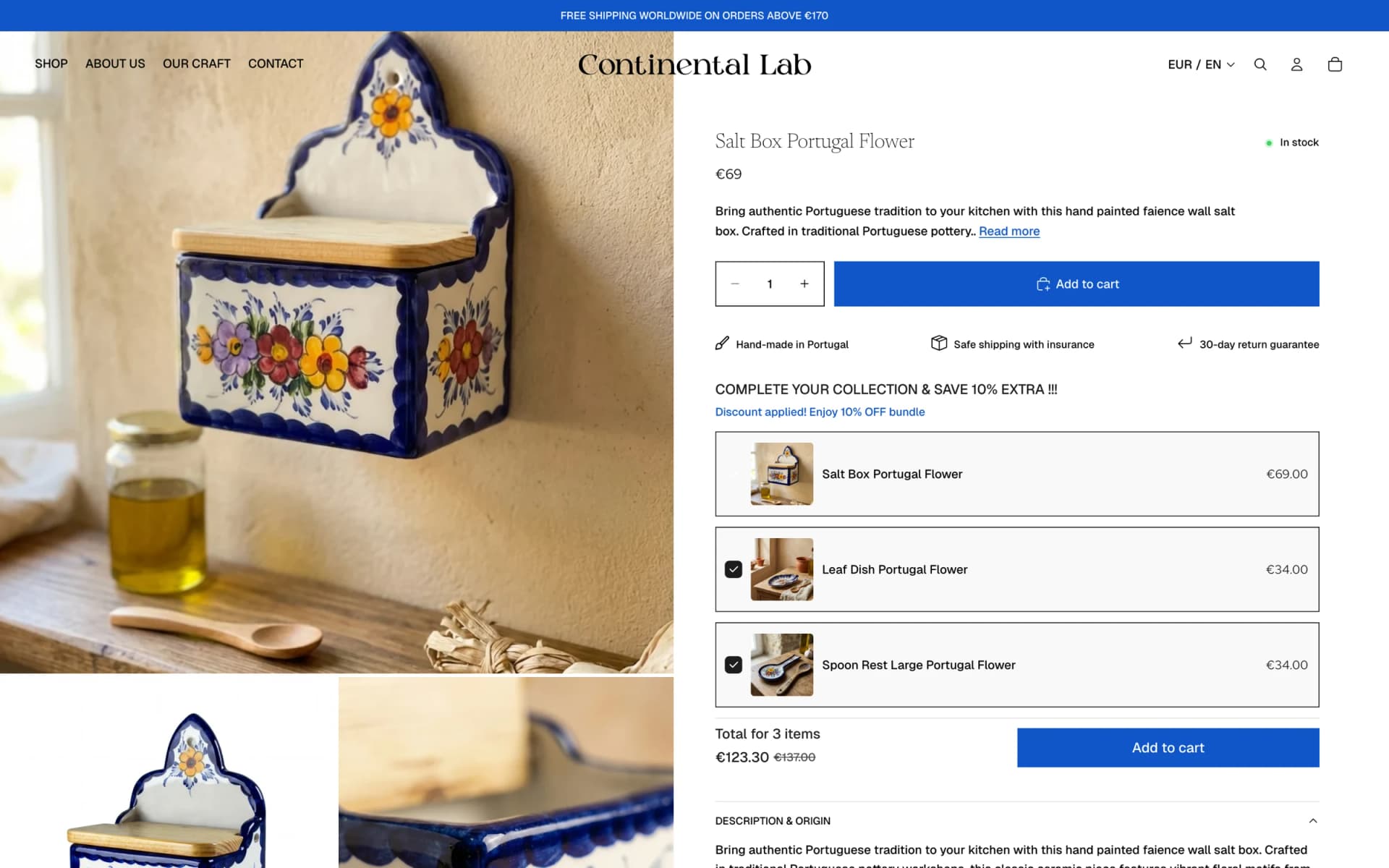
Most of the stores I have built or worked on sell well beyond their home country. Continental Lab runs in English, French and Portuguese, in euros across Europe and in US dollars for North America, Australia and Japan. Aniball sells across Europe from its own European store. Töpfer has a German storefront. Cross-border is not an add-on I bolt onto a project – it is how most of these stores were meant to work from the start.

Hynek Kraus, Shopify developer and consultant
Hynek KrausShopify developer and consultant

Which is also why I start with the question of which market is worth it next – not with switching on every country Shopify offers.

What I set up

Everything a new market needs to actually sell.

Opening a country is more than a language switcher. This is what I set up for each market – and connect so the pieces work together.

Markets and structure

Which countries first, how to group them, and how each one is served: a subfolder, a subdomain or its own domain.

  • Market selection from your own order and traffic data
  • Subfolders, subdomains or country domains
  • One store with Markets, or a separate store where it genuinely pays
Translation and localisation

A translation people can tell was machine-made costs trust at the exact moment someone decides whether to buy. Machine translation gets you a draft; the store needs more than that.

  • Translate & Adapt set up, with translated URLs and SEO fields
  • Human review of what customers actually read
  • Content adapted between markets that share a language

Currencies and prices

Customers buy in their own currency, and the price has to make sense in it. Selling in several currencies runs through Shopify Payments.

  • Local currency per market through Shopify Payments
  • Automatic or manual exchange rates, chosen deliberately
  • Prices reviewed so they read well in each currency

International SEO

A new market has to be findable in that country’s search results, not only reachable from your home page.

  • URL structure chosen for SEO, not by default
  • hreflang generated automatically and checked
  • Translated titles, descriptions and URLs

VAT, OSS and duties

VAT follows the customer across the EU, and outside it duties come into play. Shopify calculates both – the setup has to be right, and the filing stays with your accountant.

  • VAT per country, OSS and IOSS registrations
  • Duties and import taxes at checkout, with HS codes and origin
  • Setup aligned with what your accountant files

Local payments and carriers

Each market has the payment method and the carrier people expect. Without them, the checkout loses orders it should have won.

  • iDEAL, Bancontact, BLIK, Klarna and other local methods
  • The carriers and parcel lockers each market trusts
  • Shipping rates and free-shipping thresholds per market
My approach

Expansion is not a switch. It is a sequence.

Turning on twenty countries at once is easy and almost never pays. This is how I approach it instead.

One market at a time

The next market comes from your data – where orders and interest already arrive – not from a map. Once it works, the next one follows.

One store wherever possible

Shopify Markets runs many countries from one catalogue and one admin. A separate store makes sense only when a market needs a different catalogue, legal entity or warehouse.

Localise, do not just translate

Language is the start. Prices, payment methods, carriers, sizing and tone decide whether a market buys – so those get the attention too.

How it runs

From your data to a market that sells.

Every market goes through the same four steps, and what the first one teaches makes the next one faster.

  1. 01
    Choose the market

    I look at where orders, traffic and demand already come from, and what shipping, tax and language each candidate market brings with it.

  2. 02
    Plan the setup

    Structure, languages, currency, payments, carriers and tax for that market – with the one-off and monthly costs known upfront.

  3. 03
    Build and test

    I set it up and test real orders from that market end to end: price, currency, payment, shipping, VAT and the confirmation email.

  4. 04
    Launch and learn

    After launch I watch indexing, conversion and costs in the new market – and carry what worked into the next one.

A real example

Three languages, two currencies, one store.

Continental Lab sells handmade Portuguese ceramics to customers well beyond Portugal – from a single Shopify store.

Complete store from zeroPremium ceramics · worldwide

Continental Lab

A Lisbon ceramics house working since 1986, selling hand-painted pieces worldwide. I built the store and its visual design from zero. Today it runs in English, French and Portuguese, shows prices in euros across Europe and in US dollars for the United States, Canada, Australia and Japan, and offers free worldwide shipping above a set order value – one catalogue, one admin.

  • Store and visual design built from zero
  • English, French and Portuguese
  • Euros for Europe, US dollars for other regions
  • More than 40 countries in the country selector
What it costs

Priced per market, agreed upfront.

Opening a single market on an existing store usually lands in the low thousands of euros, depending on languages, integrations and how much content needs localising. A multi-market build from scratch runs to the low tens of thousands. You get the scope and the price in writing first.

What drives the price

  • How many markets and languages, and how much content has to be localised
  • Whether one store with Markets is enough, or a market needs its own store
  • Payments, carriers and accounting that have to be connected per market
  • Tax and duties setup, especially when selling outside the EU

One market, or a roadmap

You can start with a single market – a clearly bounded project with a fixed price – and decide on the next one once you see the numbers. Or we plan a roadmap of several markets and I work through them in sequence. Either way, apps and subscriptions run on your own account, not through me, and the monthly costs are known before we start.

Plan my next market

A written ballpark within 24 hours · no commitment

Common questions

What people ask before opening a new market.

One store with Markets, or a separate store per country?

One store wherever possible. Shopify Markets serves many countries from one catalogue and one admin, with their own language, currency and domain or subfolder. A separate store makes sense when a market needs a genuinely different catalogue, legal entity or warehouse. Shopify Plus includes nine expansion stores on top of the main one, but each is a fully separate store – its own data, settings and apps, nothing synced automatically – so it is a decision with a real running cost.

Which market should we open first?

The one your data already points to. Orders and traffic from a country you are not yet serving properly, shipping costs you can live with, a language you can support, and competition you can beat on something other than price. I go through that before recommending anything – it is the cheapest decision to get right and the most expensive one to get wrong.

Is machine translation good enough?

As a draft, yes; as the finished store, rarely. Shopify’s free Translate & Adapt app can translate two languages automatically and lets you edit everything by hand, including URLs and SEO fields. What customers read on product pages, in the checkout and in emails deserves a human review – a translation that reads as machine-made costs trust exactly where someone decides to buy.

How many languages can a Shopify store have?

Up to 20 on the Basic, Grow and Advanced plans, and up to 30 on Plus. In practice the limit that matters is how many languages you can support properly – with customer service, returns and content – not how many Shopify allows.

Can customers pay in their own currency?

Yes, and it matters. Selling in several currencies runs through Shopify Payments, with automatic or manual exchange rates. Local payment methods – iDEAL, Bancontact, BLIK, Klarna and others – appear for customers in the countries where they are supported. I review prices per currency so they read naturally rather than as a converted number.

Subfolder, subdomain or a separate domain – which is better for SEO?

It depends on how independent the market needs to be. Subfolders keep everything on one domain and are the simplest to run; country domains send a stronger local signal but split your authority and cost more to maintain. Shopify supports all three and generates hreflang automatically from your market and language setup. I choose with you before launch, because changing the structure later means redirects.

What about VAT and duties?

Inside the EU, VAT follows the customer once cross-border sales to consumers pass €10,000, usually handled through OSS – Shopify calculates it, but filing stays with your accountant. Selling outside your customs area brings duties: Shopify can calculate duties and import taxes at checkout on every plan, with a 0.5% fee on those orders, though not on domestic orders or orders between EU countries, and it needs HS codes and country of origin on your products.

Selling across the EU: the full guide
How long does opening a market take, and what does it cost?

A single market on an existing store is usually a matter of a few weeks, depending on how much content needs localising and what has to be connected; the price typically lands in the low thousands of euros. A multi-market build from scratch takes longer and costs more. Write a few sentences about your store and the markets you have in mind, and you get a written ballpark within 24 hours.

Get a ballpark figure
First step

Where do you want to sell next?

Write a few lines about your store and the markets you are considering. Within 24 hours you get my view in writing: which market looks worth it first, what it would take and roughly what it costs. No call, no commitment.

Would rather not fill anything in? Write straight to ahoj@hynekkraus.cz

  1. 01You fill in a short form. It takes two minutes.
  2. 02Within 24 hours I reply with a first written read on it. Free.
  3. 03What happens next is your call. I will not chase you.